 Metadata catalogue
SHP
Type of resources
Available actions
Topics
INSPIRE themes
Keywords
Contact for the resource
Provided by
Years
Formats
Representation types
Update frequencies
status
Service types
Scale
Resolution
-
The digital geological map of Greece at 1:1million scale is composed of layers of polygonal objects depicting stratigraphic units and lines depicting faults. It has been created - in the frame of the One Geology Europe Plus project - from the 1:50 000 scale map sheets, using the One Geology Europe vocabulary terms to describe lithology & age of formations.
-
Administrative divisions of Aringa, Madi, Madi-Okollo, and Terego County as of December 2001, Uganda

The shapefile represents the administrative divisions of Aringa, Madi, Madi-Okollo, and Terego County of Arua district in the North of Uganda as of December 2001. The shapefile subdivides the counties into 7 subcounties. These, in turn have 41 subdivisions that are called parishes. The parishes are further subdivided into 345 villages. We digitized the administrative units from paper maps that we have received from Uganda Bureau of Statistics in Entebbe. The associated population size on village level represents the provisional result of the Uganda census 2002.
-

The shapefile represents the administrative divisions of Adjumani district in the North of Uganda as of December 2001. The shapefile divides Adjumani district into 1 county. The county is subdivided into 5 subcounties and one town council. These, in turn have 15 subdivisions that are called parishes. The parishes are further subdivided into 73 villages. We digitized the administrative units from paper maps that we have received from Uganda Bureau of Statistics in Entebbe. The associated population size on village level represents the provisional result of the Uganda census 2002.
-
The Bouguer anomaly is defined as the difference between the gravity measured at a specific point on the Earth’s surface and a gravity value calculated at the same point assuming that the Earth’s crust is homogeneous. This map shows both the regional negative anomalies associated with the Alps and the positive anomaly of the Sesia–Finero zone that signifies an excess of mass at depth.
-
The Geological Map of Switzerland at 1:500,000 scale covers all of Switzerland and adjoining parts of neighbouring countries. It provides an overview of the distribution of the superficial geological formations exposed in Switzerland. It is thus an important tool for improving the understanding of our environment in the context of sustainable development. It is also an essential aid for education in the fields of environmental and earth sciences, as well as for the identification and prediction of natural hazards. The previous edition appeared more than 25 years ago and the new map shows a significantly improved level of detail. The addition of new data and the revision of older geological records made during recent decades have led to significant improvements in the new version. Thanks to a revised layout, the detailed legend is now easier to read and therefore easier to understand.
-
Database of mineral resources in Romania for Minerals4EU contains basic information on mineral occurences from the Geological Institute of Romania data base. Mining, exploring, resources/reserves and production statistics is not included in this version. Database is in incipient phase of completion, it will be completed with relevant inforation in next time. The information is harmonized according to specifications in the Minerals4EU project.
-
The approach to the affection of the submarine noise in the Levantine-Balear Subdivision has been made for a 5' x 5' grid, being the noise source navigation. To do this, a semi-quantitative index has been developed that integrates the analysis of AIS data (merchant vessels) and VMS data (fishing ships). For both, cells have been categorized according to the traffic intensity based on the density of AIS and VMS signals in a month. In both cases, different intensity intervals have been established, and different cases have been given different weights. In addition, adjacent cells have been selected (classified into four ranges), giving them another way of importance depending on the proximity. The zero range coincides with the cells in which the signal density was recorded, while the first range corresponds to those cells limiting with the zero level, and so on. The final result is the addition of all the weights in each cell, taking into account the maximum value for the bordering cells. The values range between 0 and 3.1, with the following levels of classification: Very High:> 2 / High: 1.71 - 2 / Medium: 0.41 - 1.7 / Low: 0.1 - 0, 4 / Very Low < 0.1
-
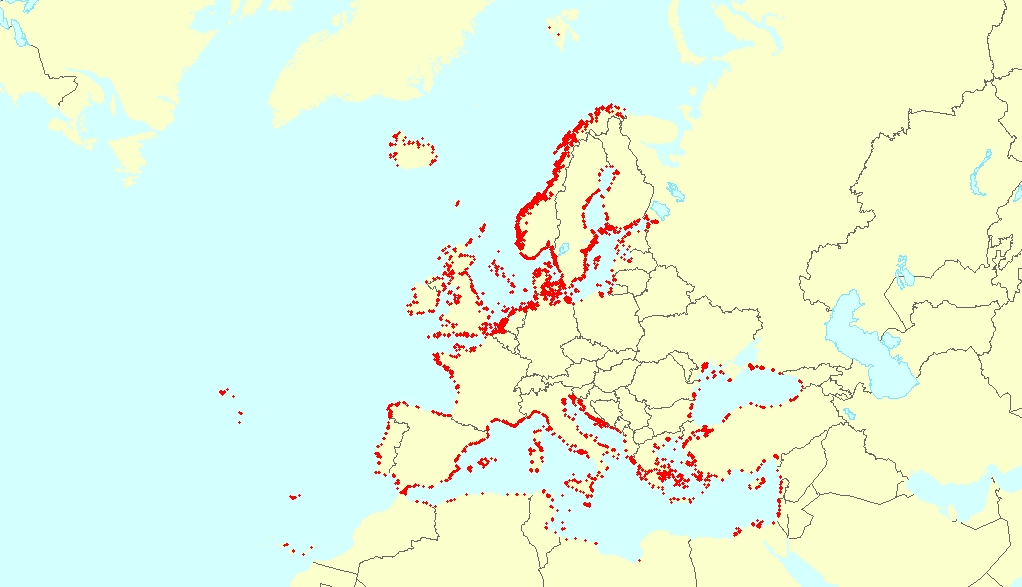
This vector dataset represents the benthic broad habitat types in Europe seas potentially affected by anchoring. The anchoring of vessels can produce damages to the seafloor and the loss of the habitat where it happens. It takes place in shallow waters, close to ports, where vessels have to wait for a spot in the port so they can load or offload (since ports have a limited amount of dockage). The anchoring areas allow vessels to safely anchor in protection from bad weather or other circumstances. The type of alterations to the habitats resulting from anchoring depend mainly on the dimensions and type of the anchor, as well as its movement resulting from the movement of the vessel due to currents or waves, which can increase the adverse effects. The dataset has been prepared in the context of the development of the first European Maritime Transport Environmental Report (to be published as an EMSA-EEA report in 2021).
-
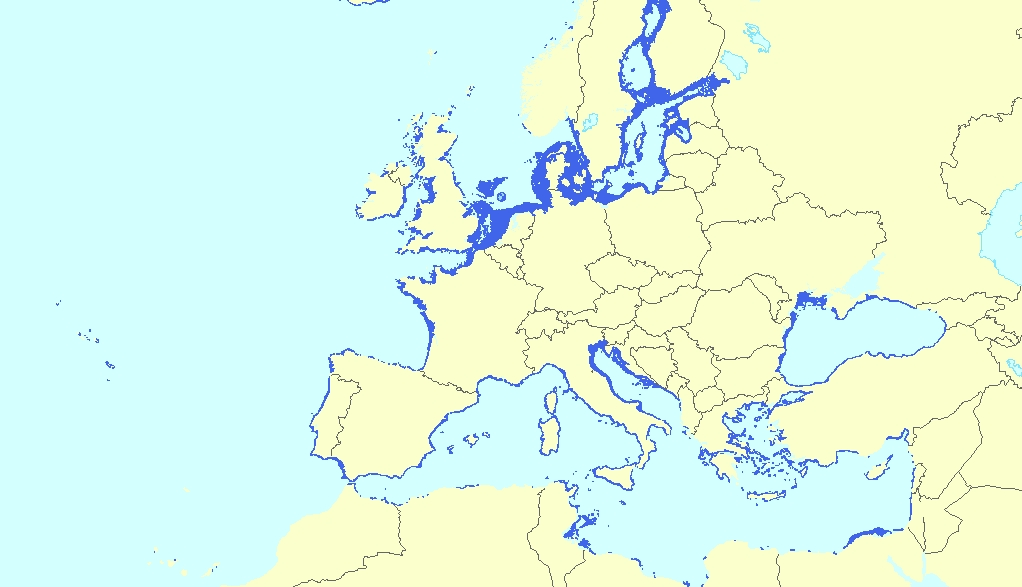
This vector dataset represents the benthic broad habitat types in Europe Seas potentially affected by the ship wakes. When navigating, the propellers of ships generate a turbulent mixing of the water that can produce sediment re-suspension in soft bottoms of shallow areas. This can increase the turbidity in those areas, affecting the seafloor organisms (especially those that are directly dependent on light, such as aquatic plants). It may also contribute to an increase of the the eutrophication level of the ecosystem (since the turbid waters may become warmer, which may turn into a reduction of dissolved oxygen in water). Finally, turbidity can produce an increase in the inputs of contaminants and microbial pathogens, since those can become attached to the suspended solids. The dataset has been prepared in the context of the development of the first European Maritime Transport Environmental Report (https://www.eea.europa.eu/publications/maritime-transport).
-
The map of “Switzerland during the Last Glacial Maximum (LGM), at a scale of 1:500,000” shows the maximum extent of glaciation in Switzerland at the height of the last Ice Age about 24,000 years BP. It incorporates the latest results of research on the Ice Age in Switzerland in a clearly legible format.