 Metadata catalogue
single-beam echosounders
Type of resources
Available actions
Topics
INSPIRE themes
Keywords
Contact for the resource
Provided by
Years
Formats
Representation types
Scale
Resolution
-
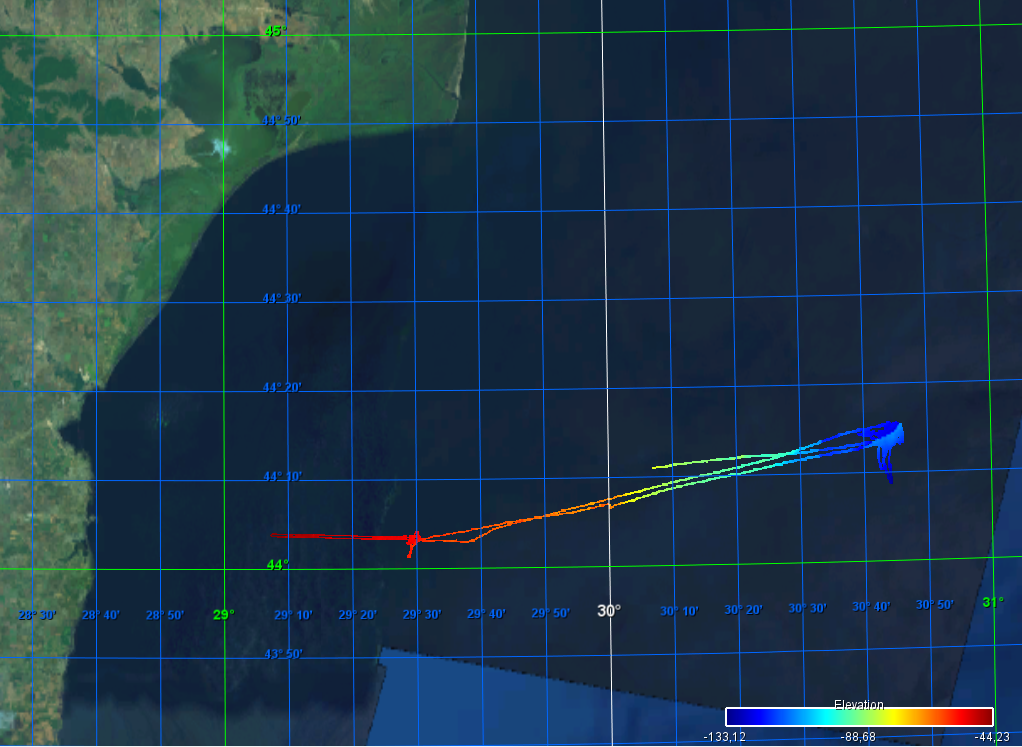
During a cruise within the ENVRI+ Project WP4, a joint pilot experiment to measure methane transfer from the seafloor to the atmosphere, bathymetry was recorded using a hull-mountes Elac Seabeam 1050 multibeam system. https://doi.org/10.1594/PANGAEA.913704 Cruise of the R/V Mare Nigrum vessel (https://www.eurofleets.eu/vessel/rv-mare-nigrum/)
-
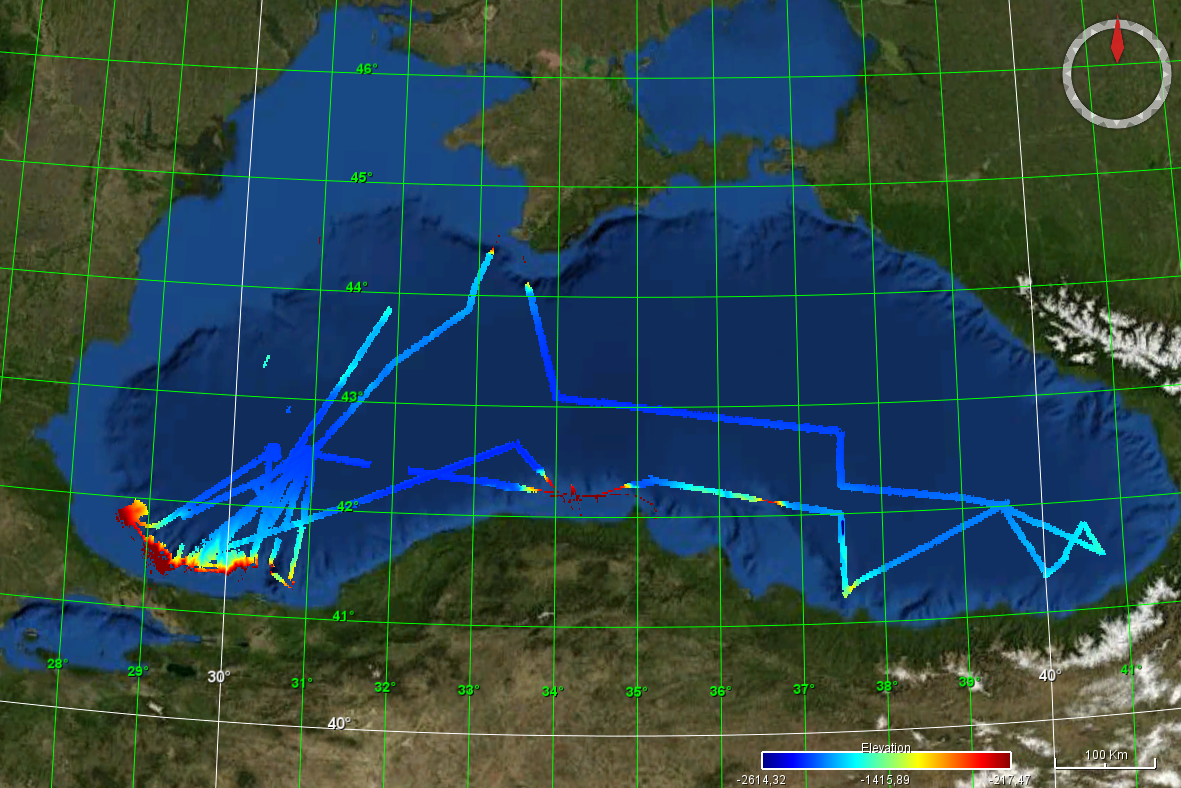
The grid is extracted from the NCEI Bathymetry Data Viewer, using the "Grid Extract" tools. https://www.ncei.noaa.gov/maps/bathymetry/
-
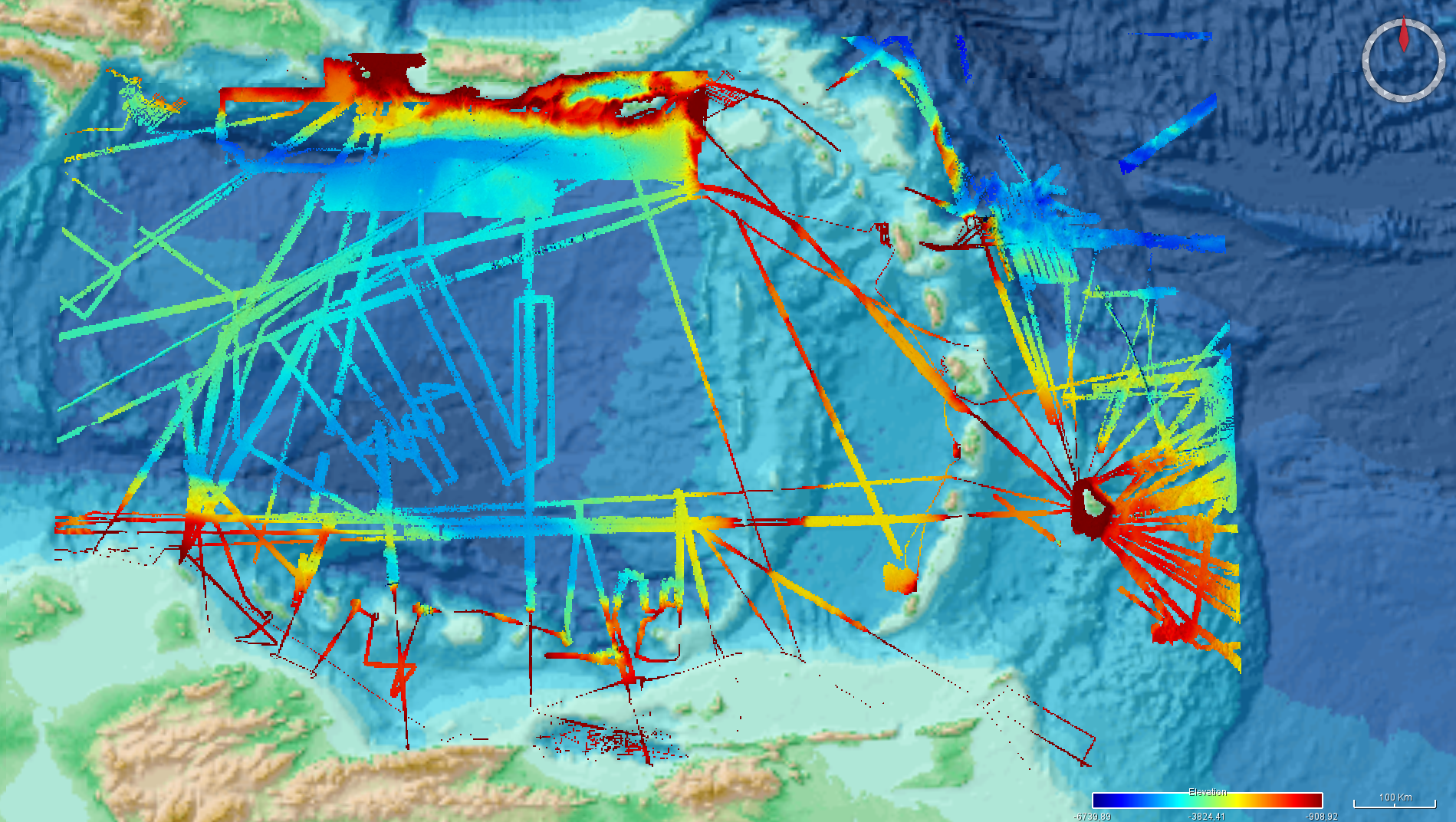
The grid is extracted from the NCEI Bathymetry Data Viewer, using the "Grid Extract" tools. https://www.ncei.noaa.gov/maps/bathymetry/
-

The bathymetry data were collected from the online data source Norge Digitalt (http://www.norgedigitalt.no) established by the Norwegian Mapping Authority, the Hydrographic service (Statens Kartverk Sjø). The original resolution is about 50m on an irregular grid. IMR has interpolated the bathymetry to four 50m x 50m UTM-grids, and simple extrapolation is applied towards a high-resolution coast line, also provided by the Norwegian Mapping Authority.
-

Systematic survey performed by IDROSPED with Singlebeam EchoSounder
-
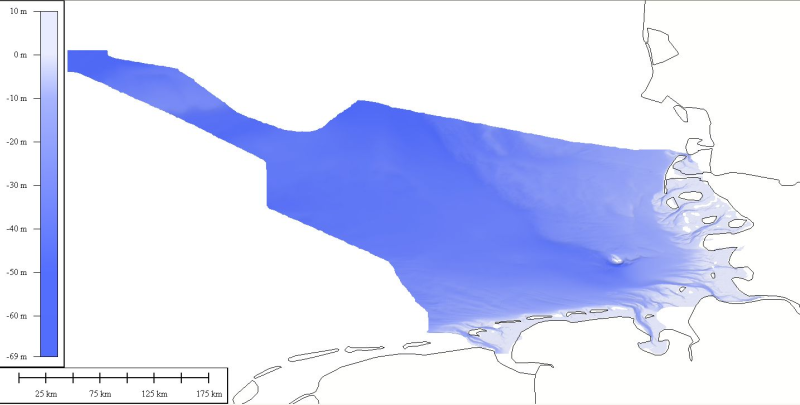
DTM data source was received from the data center (Bathymetrisches Datenzentrum) of the German Hydrographic Office (Bundesamt für Seeschifffahrt und Hydrographie) at a variable resolution. The data was then processed by ATLIS b.v. using the ATLIS SENS software suite and compiled into an EMODnet regional DTM. Although the resolution varied throughout the dataset, no interpolation was required to create a geographic grid of 0.0041667 degrees resolution.
-

The bathymetry data were collected from the online data source Norge Digitalt (http://www.norgedigitalt.no) established by the Norwegian Mapping Authority, the Hydrographic service (Statens Kartverk Sjø). The original resolution is about 50m on an irregular grid. IMR has interpolated the bathymetry to four 50m x 50m UTM-grids, and simple extrapolation is applied towards a high-resolution coast line, also provided by the Norwegian Mapping Authority.
-

The bathymetry data were collected from the online data source Norge Digitalt (http://www.norgedigitalt.no) established by the Norwegian Mapping Authority, the Hydrographic service (Statens Kartverk Sjø). The original resolution is about 50m on an irregular grid. IMR has interpolated the bathymetry to four 50m x 50m UTM-grids, and simple extrapolation is applied towards a high-resolution coast line, also provided by the Norwegian Mapping Authority.
-
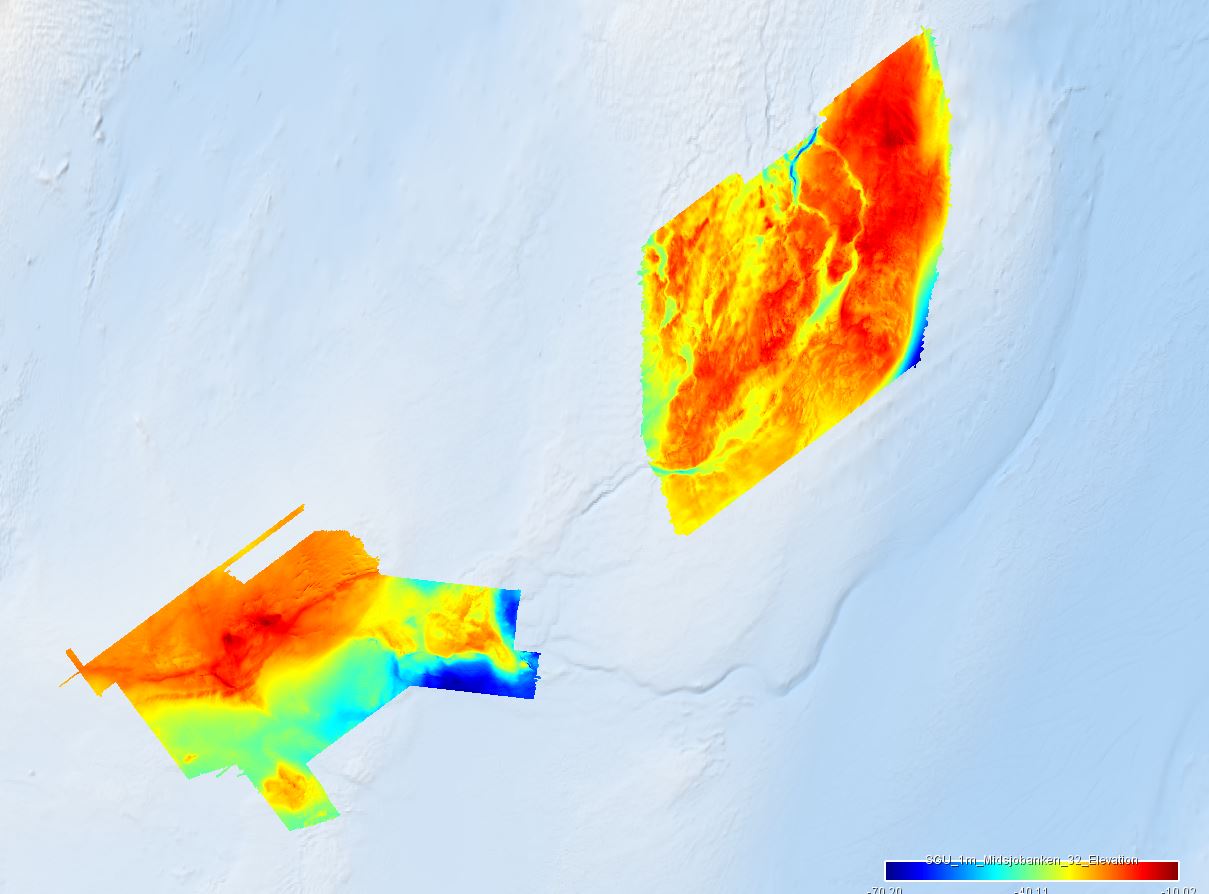
The dataset covers the areas of Northern Midsea bank (Norra Midsjöbanken) and Hoburgs bank in the Baltic Sea Region. The areas were surveyed using multibeam sonar, and collected sediment samples and high-resolution underwater images. For the EMODnet project, the data was delivered in TIFF-format and with a resolution of 1 meter for Northern Midsea and 10 meter for Hoburgs bank.
-
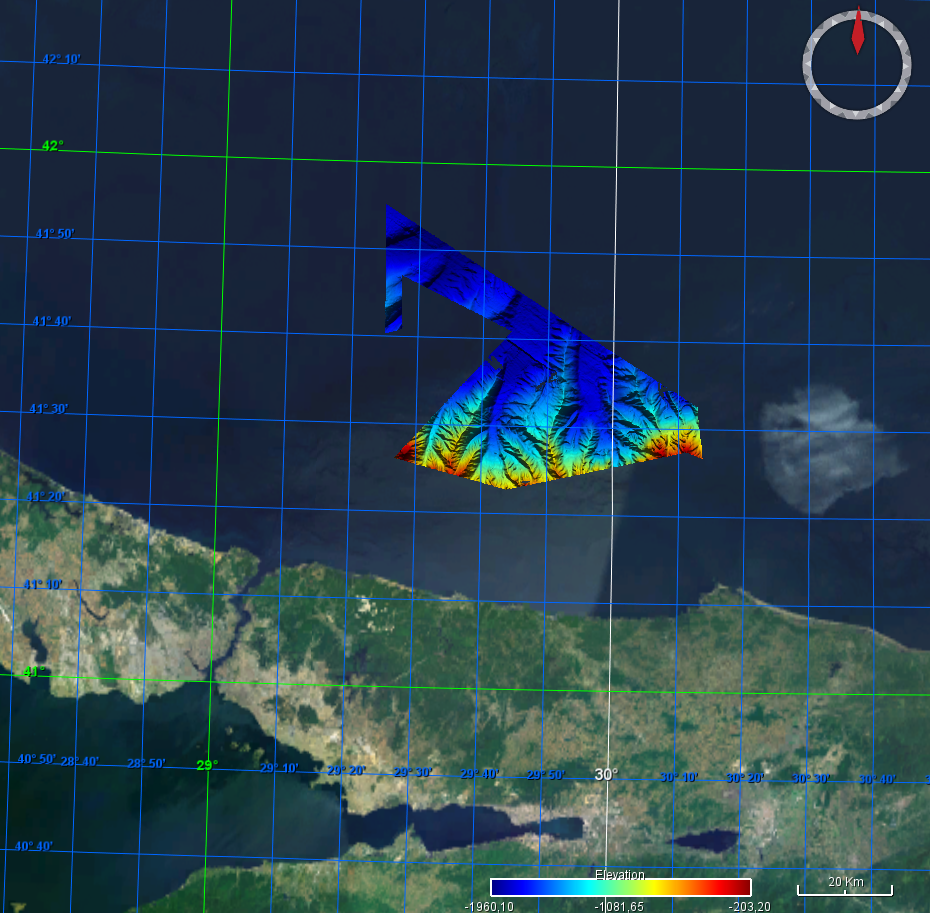
Ryan, W.B.F., S.M. Carbotte, J.O. Coplan, S. O'Hara, A. Melkonian, R. Arko, R.A. Weissel, V. Ferrini, A. Goodwillie, F. Nitsche, J. Bonczkowski, and R. Zemsky (2009), Global Multi-Resolution Topography synthesis, Geochem. Geophys. Geosyst., 10, Q03014, doi: 10.1029/2008GC002332 Extraction of the GMRT grid for the Black Sea region of EMODnet bathymetry. GMRT overview from https://www.gmrt.org/about/index.php The Global Multi-Resolution Topography (GMRT) Synthesis is a multi-resolution Digital Elevation Model (DEM) maintained in three projections and managed with a scalable global architecture that offers infrastructure for accessing the DEM as grids, images, points and profiles. A mask layer is available that highlights the location of high-resolution data. Most curatorial effort for GMRT is focused on cleaning and processing ship-based multibeam sonar data acquired by the US Academic Research Fleet (ARF) so they can be gridded at their full spatial resolution (~100m in the deep sea). These data are seamlessly overlain on lower resolution observed and predicted bathymetry data and are integrated with terrestrial elevation data to deliver to users the best resolution data that have been curated for a particular area area of interest.