 Metadata catalogue
Text
Type of resources
Available actions
Topics
INSPIRE themes
Keywords
Contact for the resource
Provided by
Years
Formats
Representation types
Update frequencies
status
Service types
Scale
Resolution
-

Geographical database that was used to create the Atlas of endemics of the Western Ghats: distribution of tree species in the evergreen and semi-evergreen forests. There are 352 endemic tree species present in the database spreaded over around 2500 locations, More information about the database is available at http://www.ifpindia.org/ecrire/upload/digital_database/Site/Endemic_Tree_Species/html/main.htm. We have migrated the database into DataManager during the Pl@ntGhats project.
-

The aerial laser scanning (ALS) dataset, acquired between 8 and 9 April 2009, covers five plots of Crique Plomb and Montagne Plomb area in French Guiana. In this area. the forest presents contrasting and diversified characteristics: high forest, forest grown on ferricrust, and superficial saprolit with high density of stem per hectare. Ground echoes are available as well as a digital terrain model (DTM), a digital surface model (DSM), a digital canopy model (DCM) with a 1 meter resolution and a triangulated irregular network (TIN) digital terrain model with a precision of 5 meters.
-
The aerial laser scanning (ALS) dataset, acquired on 20 October 2009, covers the experimental station Paracou in French Guiyana. More precisely, the dataset covers 9 plots totally (Paracou 4, Paracou 5, Paracou 7, Paracou 8, Paracou 9 - Paracou 12, and Paracou 14) and 4 plots partly (Paracou 3, Paracou 6, Paracou 13, and Paracou 15). The area includes exploited and non-exploited forest and Pinot palm.
-

Continuous hourly time-series of inshore waves spanning the period 2000-2019 are provided alongside topo-bathymetric and tide datasets. The wave dataset starts three years before topographic observations to provide antecedent conditions for morphodynamic modelling purposes. Wave parameters were derived from existing databases furnished by external organisations.
-

Continuous tidal levels spanning the period 2000-2019 are provided alongside topo-bathymetric and wave datasets. The astronomical tide dataset starts three years before beach morphological observations. Tidal levels were derived from existing databases furnished by external organisations.
-
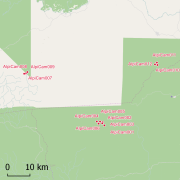
Africadiv is a network of 1-ha forest monitoring plots spread across the moist forests in central Africa. This dataset holds the inventory of tree species in the Cameroonian site of Mindourou II. In each plot, the diameter at breast height (DBH) of all trees with DBH ≥ 10 cm have been measured (n=5598). All trees were identified in the field by expert botanists. Leaves samples were frequently collected for genetic analyses along with herbarium samples. The herbarium and leave samples are conserved at the Herbarium of the Université Libre de Bruxelles (BRLU, Belgium) and the determination of the samples is frequently updated by ULB's botanists. End of 2016, the identification rate was: 56.4% on species-level, 26.2% on genus-level, 11.7% on family-level. 5.7% remained unidentified.
-

The aerial laser scanning (ALS) dataset, acquired in 2004, covers the Sinnamary area in French Guiana.
-

This data set reports woody plant species abundances in a network of 96 sampling sites spread across 22000 km² in central Western Ghats region, Karnataka, India . The database stores abundance and girth data for 76813 trees and lianas of 446 species collected in 96 sampling sites during 1996-1997. A total of 61965 individuals >10 cm girth at breast height (gbh) were recorded in 96 1-ha macroplots, while 14848 individuals <10 cm gbh but >1 m height were sampled in three 0.1-ha microplots located within each macroplot. Additional data regarding the stand structure (average canopy height, percent canopy cover, number of strata) and the level of degradation are available for the macroplots, along with environmental data derived from other sources and analyses, such as soil types, rainfall, length of the dry season, and altitude. These data have been used to produce ecological research papers as well as to elaborate conservation value maps and recommendations toward sustainable management of the forests of the central Western Ghats region. We have migrated the initial database available at http://esapubs.org/Archive/ecol/E091/216/default.htm to DataManager during the Pl@ntGhats project.
-

Data set on demography of trees monitored over 20 years in Uppangala permanent sample plot (UPSP) in undisturbed, old-growth wet evergreen Dipterocarp forest located within the Pushpagiri Wildlife Sanctuary in India's Western Ghats biodiversity hotspot. During 1989–1990, all trees ≥30 cm girth at breast height (gbh) were sampled in five north–south transects 20 m wide and 180–370 m long covering a total area of 3.12 ha. In 1992–1993, additional rectangular plots were established, bringing the total area sampled to 5.07 ha. In all, 3870 trees were identified, tagged, mapped, and provided with permanent dendrometer bands. Since then, the sampled area has been regularly censused at 3–5-year intervals, recording tree recruitment, mortality, and growth. We present data from censuses conducted in 1990–1993, 1994, 1997–1998, 2001–2002, 2007, and 2010. These data have been used to study the natural forest dynamics and to calibrate spatially explicit simulation models.
-

The aerial laser scanning (ALS) dataset, acquired on October 2004, covers the experimental station Paracou in French Guiyana. More precisely, the dataset covers all Paracou plots totally except of plot 15 that is only covered partly. The area includes exploited and non-exploited forest and Pinot palm. Ground echoes are available as well as a digital terrain model (DTM), a digital surface model (DSM) , and a digital canopy model (DCM) with a 1 meter resolution.