 Metadata catalogue
The James Hutton Institute
Type of resources
Available actions
Topics
INSPIRE themes
Keywords
Contact for the resource
Provided by
Years
Formats
Representation types
Update frequencies
status
Service types
Scale
Resolution
-
The map shows the risk of the topsoil becoming compacted due to the passage of machinery. This map primarily covers the cultivated land in Scotland and provides information on the risk of topsoil compaction.The topsoil compaction risk gives information of the likelihood of the topsoil becoming compacted in 3 classes: High, Moderate or Low. The risk is based on the natural drainage class of the soil and the soil texture.
-
The map shows the risk of water flowing overland (runoff) carrying potential pollutants into water courses. This map primarily covers the cultivated land in Scotland. The digital dataset gives information on the likelihood of a potential pollutant applied to the soil surface running off the land to a water course in 3 classes: Low, Moderate or High and is based on fundamental soil characteristics such as depth to a slowly permeable layer, soil porosity and flow pathways through the soil.
-
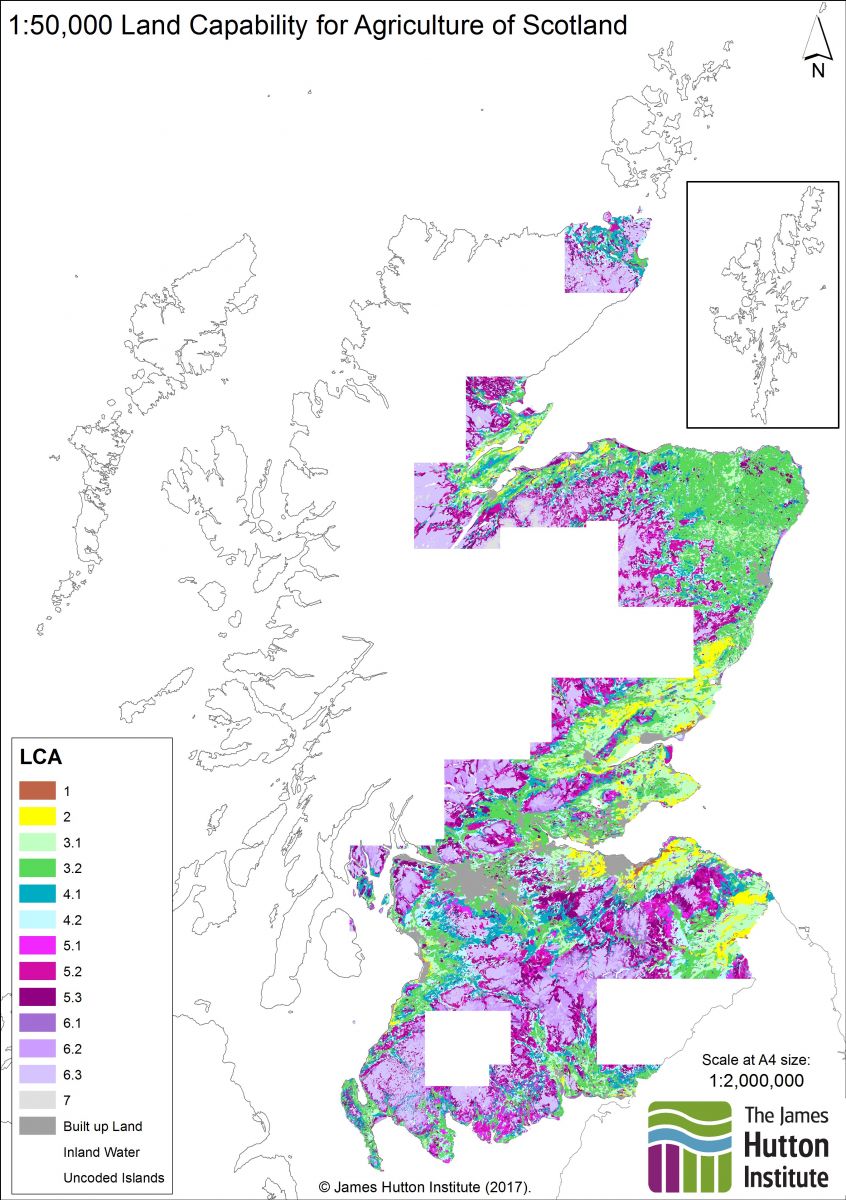
The Land Capability Classification for Agriculture has as its objective the presentation of detailed information on soil, climate and relief in a form which will be of value to land use planners, agricultural advisers, farmers and others involved in optimising the use of land resources. The classification ranks land on the basis of its potential productivity and cropping flexibility determined by the extent to which its physical characteristics (soil, climate and relief) impose long term restrictions on its agricultural use. THE CLASSES Class 1. Land capable of producing a very wide range of crops with high yields Class 2. Land capable of producing a wide range of crops with yields less high than Class 1. Class 3. Land capable of producing good yields from a moderate range of crops. Class 4. Land capable of producing a narrow range of crops. Class 5. Land suited only to improved grassland and rough grazing. Class 6. Land capable only of use as rough grazing. Class 7. Land of very limited agricultural value. THE DIVISIONS A division is a ranking within a class. As the requirements of the crops suited to Classes 1 and 2 are fairly stringent, land in these classes has inherently low degrees of internal variability and no divisions are present. The requirements of crops grown in the remaining classes are less rigorous, consequently land included is more variable in character.
-
The map shows the risk of potential pollutants and nutrients leaching through the soil to ground and surface waters. This map primarily covers the cultivated land in Scotland. The soil leaching potential gives information on the likelihood of a potential pollutant that is applied to the soil surface infiltrating the soil and leaching to a water course or ground water in three main categories (High, Intermediate and Low) with the High class being subdivided into 3 classes while the intermediate class is subdivided into 2 classes. Note: soils over current and restored mineral workings and in urban areas that are often disturbed or absent are assumed to have little ability to retain potential pollutants and so are classified as having a high leaching potential (see Lewis, M.A., Lilly, A and J.S. Bell. 2000. Groundwater vulnerability mapping in Scotland: Modifications to classification used in England and Wales. In: Groundwater in the Celtic Regions: Studies in Hard Rock and Quaternary Hydrogeology. Eds. N.S. Robins and B.D.R. Misstear Geological Society Special Publication No. 182. pp 71-79.).
-
The map shows the risk of a bare soil being eroded by water under intense or prolonged rainfall and primarily covers the cultivated land in Scotland. Soils with mineral topsoils have been classified separately from those with organic (peaty) surface layers. The risk of soil erosion is shown in 3 main classes for soils with mineral topsoils; High, Moderate or Low. The risk of erosion is greatest on coarse textured soils with a low water adsorption capacity on steep slopes. Each main class is divided into 3 subclasses (H1-3, M1-3 and L1-3) with the greater numbers in each risk class indicating a higher risk of erosion due to increases in slope, soil textures becoming more coarse and/or the soils having a lesser ability to absorb rainfall. The risk of soil erosion for soils with organic (peaty) surfaces is also shown in 3 classes; High, Moderate or Low. The Moderate and Low erosion risk classes are divided into subclasses (Mi–iv and Li-iii) with the greater numbers (i-iv) in each risk class indicating a higher risk of erosion due to increases in slope and/or the soils having a lesser ability to absorb rainfall.
-
The map shows the vulnerability of subsoils to compaction by traffic. It covers most of Scotland’s cultivated agricultural land area. The subsoil compaction risk gives information on the likelihood of the subsoil becoming compacted due to heavy machinery in four classes (Extremely vulnerable, Very vulnerable, Moderately vulnerable or Not particularly vulnerable) based on the soil texture and the amount of water left in the soil after any excess has drained away (known as field capacity).
-
This service is the digital (vector) version of the Land Capability for Agriculture of Scotland 1:50,000 maps. Also known as "Land capability for agriculture (partial cover)". Refer to the datasets for more information.
-

This service is the digital (vector) version of the Land Capability for Agriculture of Scotland 1:250,000 maps. Refer to the datasets for more information.
-

The systematic survey of the soils of Scotland was commenced in 1947 by staff of the Macaulay Institute for Soil Research. This dataset is the digital (vector) version of the Soils of Scotland 1:250,000 maps, which is a generalised soil map, partly derived from a 1:50,000 map of the soils of Scotland. This dataset is an inventory of the soils of Scotland and was intended for use by planners etc. This dataset has the soil lines extrapolated over the built-up areas. The soil classification used was updated in 2013 to provide a unified classification across all Soil Survey of Scotland soil maps and profile datasets(UCSS).Version 1.1 of the data includes both the original 1984 and the 2013 soil classification.
-
This service is the digital (vector) version of the Soils of Scotland 1:250,000 maps plus the National Soil Inventory of Scotland 10 km survey. Refer to the datasets for more information.