 Metadata catalogue
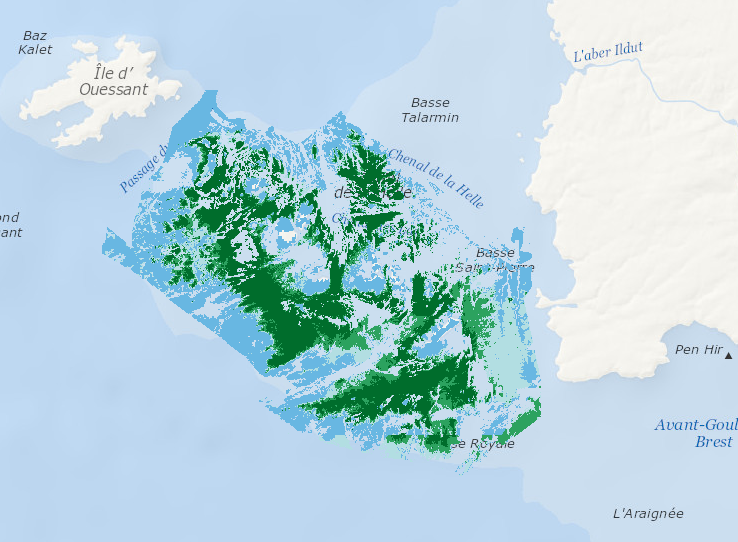
Kelp species L. digitata and L. hyperborea mapping along Molène Archipelagos (France)
Data represents percentage cover of kelp forest as well as biomass of the 2 main species: L. digitata and L. hyperoborea.
The used approach consists in firstly establishing surveys and appropriate processing methods in order to provide a detailed underwater topography of the area and to accurately delineate hard substrates (bedrock) potentially colonized by kelp. Secondly, a habitat suitability model is fitted for each species on some carefully selected field stations, measuring kelp presence/absence and biomass. Predictive maps are produced, based on hard substrate areas previously delineated.
|
|
Citation proposal
Bajjouk Touria (IFREMER) (2015) . Kelp species L. digitata and L. hyperborea mapping along Molène Archipelagos (France). IFREMER https://services.mspdata.eu:/geonetwork/srv/api/records/4adbe32a-8c81-4c18-8da3-4c361889820c |
Simple
- Date ( Publication )
- 2015-01-01T00:00:00
- Identifier
-
IFR_MOLENE_BIOMASSE_MINMEDMAX_PRESENCE_ABSENCE
- Identifier
-
DOI:10.12770/4adbe32a-8c81-4c18-8da3-4c361889820c
- Credit
-
Bajjouk T., Rochette S., Laurans M. Ehrhold A., Hamdi A. and Le Niliot Ph. (2015). Multi-approach mapping to help spatial planning and management of the kelp species L. digitata and L. hyperborea: Case study of the Molène Archipelago, Brittany. Journal of Sea Research. 100:2-21
Author
Centre Bretagne - ZI de la Pointe du Diable - CS 10070 - 29280 Plouzané
Brest
France
Publisher
- GEMET - INSPIRE themes, version 1.0 ( Theme )
-
-
Habitats and biotopes
-
- Thèmes Sextant ( Theme )
-
-
/Biological Environment/Habitats
-
- Use limitation
-
Creative Commons license to apply : Attribution + Non Commercial + No Derivs (BY-NC-ND) : http://creativecommons.org/licenses/?lang=en
- Access constraints
- Other restrictions
- Use constraints
- Copyright
- Other constraints
-
unrestricted
- Spatial representation type
- Grid
- Distance
- 5 meter
- Metadata language
- English
- Character set
- UTF8
- Topic category
-
- Environment
))
- Reference system identifier
-
EPSG
/WGS 84 (EPSG:4326)
/8.6
- Number of dimensions
- 2
- Dimension name
- Column
- Dimension size
- 5011
- Dimension name
- Row
- Dimension size
- 3044
- Cell geometry
- Area
- Transformation parameter availability
- true
- Distribution format
-
- ()
- OnLine resource
-
IFR_MOLENE_BIOMASSE_MINMEDMAX_LD
Biomass - Laminaria digitata
- Protocol
-
FILE
- Name
-
IFR_MOLENE_BIOMASSE_MINMEDMAX_LD
- Description
-
Biomass - Laminaria digitata
- OnLine resource
-
IFR_MOLENE_BIOMASSE_MINMEDMAX_LH
Biomass - Laminaria hyperborea
- Protocol
-
FILE
- Name
-
IFR_MOLENE_BIOMASSE_MINMEDMAX_LH
- Description
-
Biomass - Laminaria hyperborea
- OnLine resource
-
IFR_MOLENE_PRESENCE_ABSENCE_LD
Presence/Absence - Laminaria digitata
- Protocol
-
FILE
- Name
-
IFR_MOLENE_PRESENCE_ABSENCE_LD
- Description
-
Presence/Absence - Laminaria digitata
- OnLine resource
-
IFR_MOLENE_PRESENCE_ABSENCE_LH
Presence/Absence - Laminaria hyperborea
- Protocol
-
FILE
- Name
-
IFR_MOLENE_PRESENCE_ABSENCE_LH
- Description
-
Presence/Absence - Laminaria hyperborea
- OnLine resource
- DOI du jeu de donnée
- Hierarchy level
- Dataset
Conformance result
- Date ( Publication )
- 2010-12-08
- Explanation
-
See the referenced specification
- Statement
-
A habitat distribution modelling approach was used to model the spatial distribution of the two main species of kelp forests along Molène archipelagos (France).
Lineage:
Data represents percentage cover of kelp forest as well as biomass of the 2 main species: L. digitata and L. hyperoborea.
The used approach consists in firstly establishing surveys and appropriate processing methods in order to provide a detailed underwater topography of the area and to accurately delineate hard substrates (bedrock) potentially colonized by kelp. Secondly, a habitat suitability model is fitted for each species on some carefully selected field stations, measuring kelp presence/absence and biomass. Predictive maps are produced, based on hard substrate areas previously delineated.
Type of occurrence data used:
In situ data were acquired in the period from late summer to early autumn. Information on the presence/absence of Laminaria species was acquired by towing a high definition video. Species-specific biomass were sampled at low tide for the intertidal areas and by Scuba diving for the sub-tidal areas.
Environmental covariates/explanatory variables:
Presence–absence of L. digitata distribution was best determined through the combined effects of depth, sediment proximity along current direction, benthic position index (BPI), immersion rate and winter temperature.
The sub-model for biomass of L. digitata where present, was predicted using the additional contribution of several variables, with light being the most important (55.62% of deviance explained) and its interactions withwave exposure and spring temperature. Total suspended matter contributed little and only then through the interaction with light.
The best model that explained 78.89% of deviance for the presence of L. hyperborea included depth, winter temperature, sediment proximity along current direction and BPI
Biomass where L. hyperborea was present was mainly modeled by the same predictors as presence/absence
Algorithm/modelling approach:
Kelp biological response (presence/absence or biomass) was estimated using Generalized Additive Models (GAM)
Metadata
- File identifier
- 4adbe32a-8c81-4c18-8da3-4c361889820c XML
- Metadata language
- English
- Character set
- UTF8
- Hierarchy level
- Dataset
- Date stamp
- 2019-02-06T15:37:23
- Metadata standard name
-
ISO 19115:2003/19139 - SEXTANT
- Metadata standard version
-
1.0
Point of contact
Centre Bretagne - ZI de la Pointe du Diable - CS 10070 - 29280 Plouzané
Brest
France